Ten steps to the perfect puppy.
K9 Academy's puppy handbook, by head trainer Anesh Srikrishnakumar: the ten steps we recommend to all our clients, from the crate and the daily schedule to what to buy and what to skip.
- Make your puppy work for their food, and four exercises to earn it
- Crate training do's and don'ts, from day one
- Daily schedules for working 9 to 5, working from home, or self-employed
- What to buy, what to avoid, and what to teach first
30-day money back guarantee · Instant download · No account needed to buy

34 pages · 4.0 MB
Sound familiar?
“They’re just a puppy” turns into habits
“She cries in the crate, so I let her out.”
Don’t. The crate is a proactive tool, never a punishment, and the rule is clear: don’t let your puppy out while they’re whining or barking. Step 2 has the rest.
“I work full time. How does a puppy fit?”
There’s a daily schedule for working 9 to 5, with a dog walker at 10 and 3. And don’t take time off work: it creates a very dependent dog.
“He barks until he gets what he wants.”
Most barks mean “I want something”, not “I need something”. Giving in stops a puppy learning to self-regulate, and that’s how separation anxiety develops.
“The pet store has a hundred things. What do I need?”
Step 7 lists what to buy, the toys we love, and what to leave on the shelf, from bungee leashes to pee pads.
How it works
Ten steps, in four parts
- 01
Set the rules
Make your puppy work for their food, use the crate from day one, and keep them leashed inside.
- 02
Build the routine
Pick the daily schedule that fits your week, don’t give in to barking, and keep commands short and clear.
- 03
Get the right gear
What to buy, the toys worth having, and four things to skip.
- 04
Teach and troubleshoot
What to teach first, the puppy don’ts, and how to work on nervousness, possessiveness or stubbornness.
Take a look inside
Ten steps, one page at a time
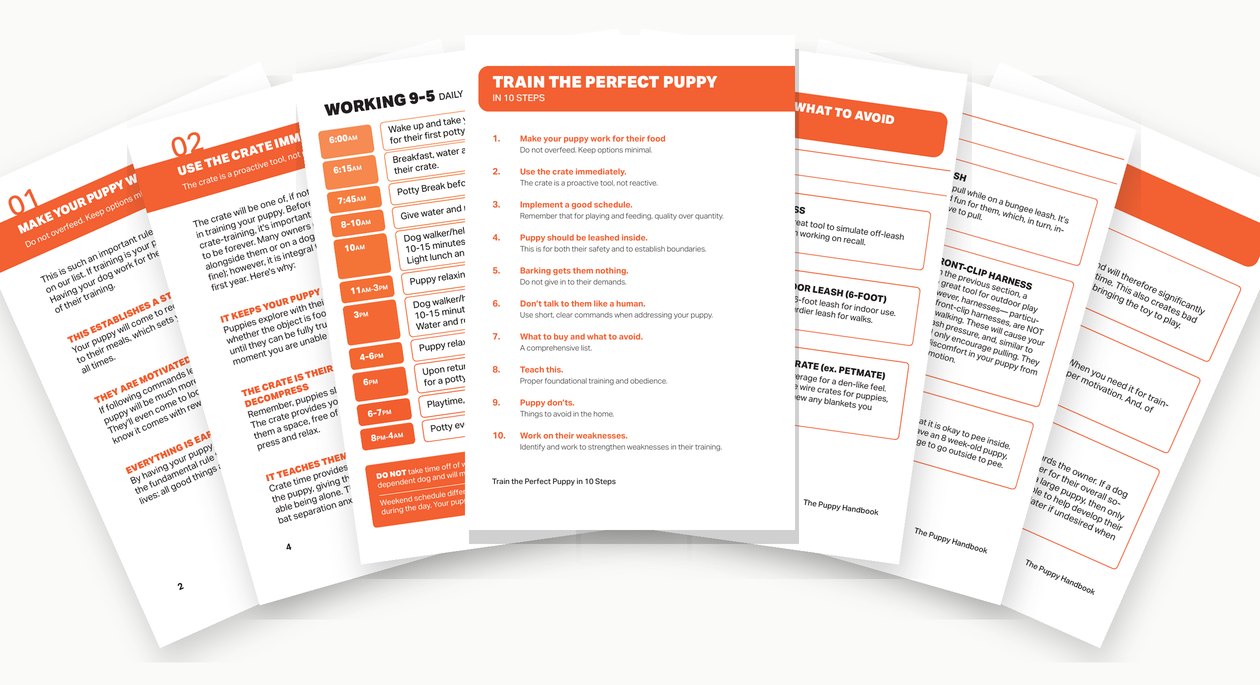
- Work for food
- Crate do’s and don’ts
- 3 daily schedules
- What to buy
- What to skip
- What to teach first
What not to buy
Four things to leave on the shelf
Skip
Bungee leash
It’s comfortable and fun to pull against, so your puppy pulls more.
Skip
Front-clip “Easy Walk” harness
A regular harness is great for play. Front-clip ones teach a puppy to hate leash pressure, encourage pulling and limit their movement.
Skip
Pee pads
They teach your puppy it’s okay to pee inside. Even an 8-week-old puppy can go outside.
Skip
Heartbeat toy
A choking hazard in the crate, and a distraction from learning to settle on their own.
What’s inside
Everything in the handbook
- p. 2
1. Make your puppy work for their food
Why food is their pay, and four exercises to earn it
- p. 4
2. Use the crate immediately
Safety, decompression and independence, plus crate training do’s and don’ts
- p. 6
3. Implement a good schedule
Hour-by-hour schedules for working 9 to 5, working from home, and self-employed or weekends
- p. 10
4. Puppy should be leashed inside
Safety, boundaries, the slip lead, and using the leash to teach sit and down
- p. 12
5. Barking gets them nothing
“I want” versus “I need”, and what to do about night-time cries
- p. 15
6. Don’t talk to them like a human
Short, clear commands, with examples
- p. 16
7. What to buy and what to avoid
The gear to buy, the toys we love, and four things to skip
- p. 22
8. Teach this
Engagement, name, recall, eye contact, sit, down and place, the leash walk, and settling in
- p. 24
9. Puppy don’ts
Toys and food left out, worrying about jumping, fixating on other dogs, and over-correcting
- p. 26
10. Work on their weaknesses
How to handle nervousness, possessive tendencies, and a hard-headed puppy
This is for you if…
- You’re bringing home a puppy soon, or you just did
- You want clear rules from day one, not a hundred conflicting tips
- You work full time or from home and need a schedule that fits
- You want to know what gear to buy and what to skip
It’s not for you if…
- You want a week-by-week planner. The handbook is ten clear steps and the reasons behind them; for weekly schedules and logs, see The New Puppy Workbook.
- Your dog is already grown. Some steps still apply, but the handbook is written for puppies.
Who wrote it
Written by head trainer Anesh Srikrishnakumar
The Puppy Handbook is written by Anesh Srikrishnakumar, K9 Academy’s head trainer. K9 Academy has trained dogs in Toronto since 2011, more than 10,000 of them in person, and these are the steps and methods it recommends to all its clients.
Everything you get
The Puppy Handbook
- The 34-page handbook (PDF)
- The 10 steps, each with the reasons behind it
- Three daily schedules to fit your work
- What to buy, the toys we love, and what to skip
- What to teach first, and the puppy don’ts
- Instant PDF download, yours to keep
One private lesson with a trainer costs $225 or more.
The handbook:$14
One payment · instant download

Want to see it done? Take the video course
Puppy Program
Everything you need for a puppy that grows into a well-behaved adult — from potty training to socialization to bite inhibition.
- 13 modules on video
- The Puppy Handbook comes with it, plus 6 more downloads
- Watch at your own pace, on any device
Questions
Frequently asked questions
Is this a physical book?
No. It's a 34-page PDF you download straight after checkout, to read on your phone, tablet or computer.
When should I start?
The day your puppy comes home. Step 2 is “use the crate immediately”.
Does it use corrections?
Very little. One of the puppy don'ts is over-correcting: build a strong relationship first. The leash does most of the guiding.
How is it different from The New Puppy Workbook?
The handbook is the ten steps and the reasons behind them. The workbook is the week-by-week planner and log from 8 weeks to 6 months. They work well together.
What if it doesn't help?
You're covered by our 30-day money back guarantee. Email info@k9academy.ca for a full refund.
Start on day one
Download The Puppy Handbook, set up the crate, and pick the daily schedule that fits your week.
30-day money back guarantee · Instant download
The Puppy Handbook
$14 · instant download